
By Dr. Ashish Kumar Ohri
General & Laparoscopic Surgeon
Vice President, IMA Punjab
Joint Secretary, Association of Surgeons of India – Punjab Chapter
Bleeding during bowel movements, repeated swelling near the anus, pus discharge or a painful lump between the buttocks can be uncomfortable symptoms to discuss.
Many patients continue suffering silently because they feel embarrassed. Others delay treatment because they are worried about surgery, hospitalisation or medical expenses.
However, delaying medical evaluation does not make the disease disappear. Repeated bleeding, infection and inflammation may make the condition more complicated and affect everyday life.
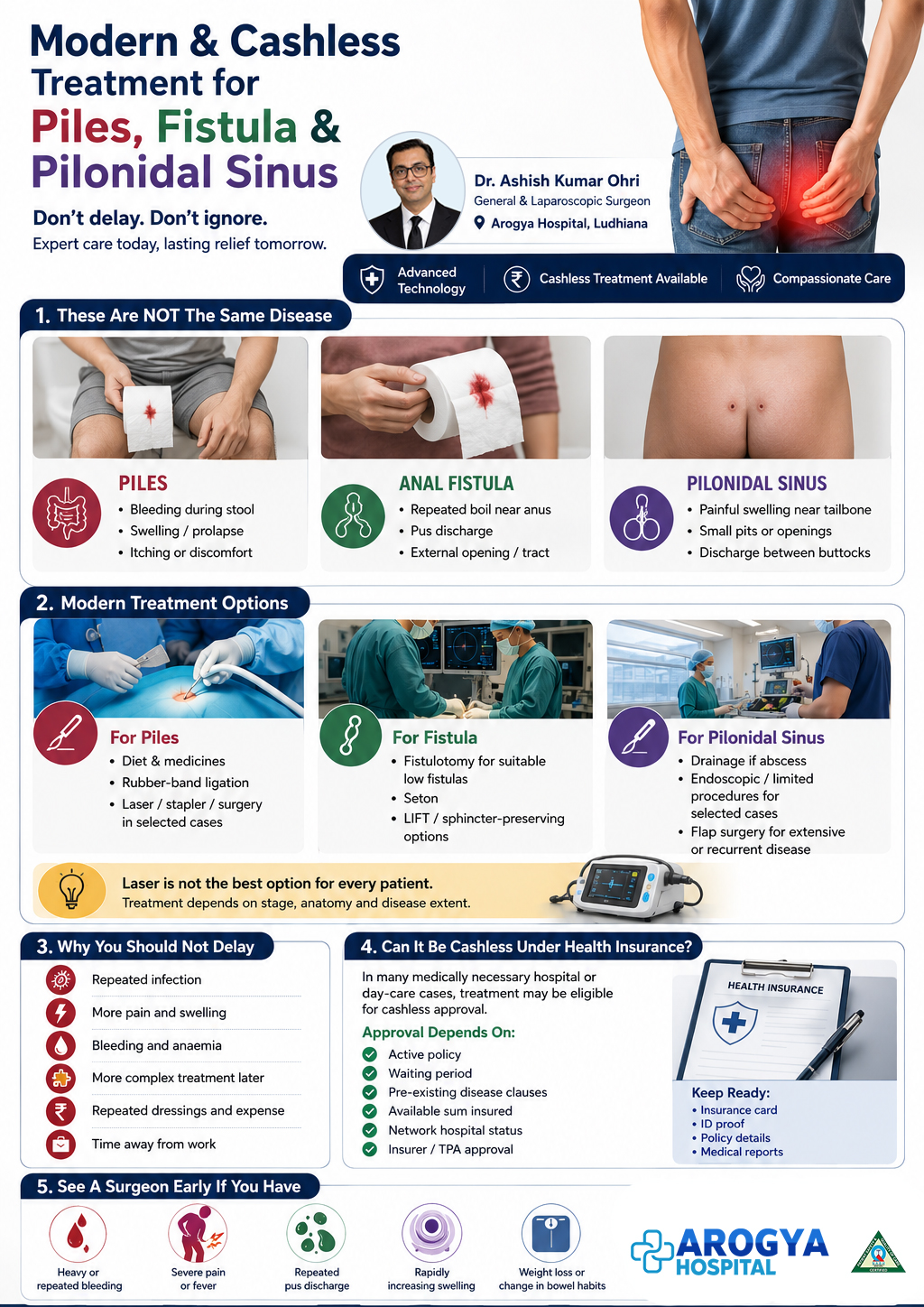
Modern treatment options are now available for piles, fistula-in-ano and pilonidal sinus. Depending on the diagnosis and severity, selected procedures may be performed as day-care or short-stay surgery. Treatment may also be eligible for cashless approval under a health-insurance policy, subject to policy conditions and approval by the insurer or TPA.
The first step is to identify the condition correctly.
Patients often use the word “piles” for every problem involving pain, bleeding, swelling or discharge around the anus. However, piles, anal fistula and pilonidal sinus are different conditions. Each requires a different treatment approach.
Think of empanelled hospitals as trusted partners in your health insurance network. These are hospitals that have formal agreements with insurance companies to provide direct billing services. When you're admitted to an empanelled hospital, a dedicated team coordinates with your insurance provider through Third-Party Administrators (TPAs) or direct insurer desks.
This partnership ensures a smooth financial process. The hospital submits treatment details and estimated costs to the insurer, who then approves and directly pays the bill, minus any policy exclusions or sub-limits.
- Fresh bleeding during or after passing stool
- A lump coming out during bowel movements
- Itching or irritation around the anus
- Mucus discharge
- Pain or swelling in some cases
Early piles may improve with constipation control, adequate water intake, a fibre-rich diet, regular exercise and appropriate medicines.
When symptoms continue, treatment may include rubber-band ligation or surgery, depending on the grade and type of piles. Surgical options may include laser-assisted treatment, stapled procedures, haemorrhoidal artery ligation or conventional haemorrhoidectomy.
No single procedure is suitable for every patient.
The word “laser” should not replace proper diagnosis. The best treatment depends on:
- Grade of piles
- Internal and external components
- Amount of bleeding
- Previous treatment
- Associated medical conditions
- Individual anatomy
Persistent rectal bleeding should never automatically be assumed to be due to piles. Further evaluation may be required, particularly when bleeding is associated with anaemia, unexplained weight loss, altered bowel habits or a family history of colorectal disease.
An anal fistula is an abnormal tract between the anal canal and the surrounding skin. It commonly develops after an anal abscess.
Possible symptoms include:
- Repeated painful swelling near the anus
- Pus or watery discharge from a small opening
- Temporary relief after the swelling bursts
- Recurrent infection or fever
- Irritation and staining of undergarments
Antibiotics may temporarily reduce infection, but they usually do not eliminate an established fistula tract.
The purpose of fistula treatment is not simply to close the external opening. The surgeon must identify the tract and treat it while protecting the anal sphincter muscles responsible for bowel control.
- Fistulotomy for suitable low and simple fistulas
- Seton placement
- LIFT procedure
- Advancement flap
- Video-assisted fistula treatment
- Selected laser-based closure procedures
Complex or recurrent fistulas may require an MRI fistulogram or detailed assessment. Some patients may need staged treatment to reduce the risk of recurrence and preserve continence.
There is no single operation that is ideal for every fistula.
A pilonidal sinus usually develops in the cleft between the buttocks, close to the tailbone. Hair and debris may enter the skin and cause repeated inflammation or infection.
- Painful swelling near the tailbone
- One or more small openings in the skin
- Pus, blood or foul-smelling discharge
- Difficulty sitting comfortably
- Repeated abscess formation
This condition is commonly seen in young adults, drivers, office workers and people who sit for long periods.
An acutely infected abscess may first require drainage. Further treatment depends on the number of openings, the extent of the sinus tracts and whether the disease has returned after earlier treatment.
- Pit-picking or limited excision
- Endoscopic cleaning of the sinus
- Selected laser-ablation procedures
- Excision with off-midline closure
- Flap surgery for extensive or recurrent disease
Minimally invasive treatment may be suitable for limited disease. More extensive or recurrent disease may require a more comprehensive procedure.
Many patients repeatedly take antibiotics, painkillers or home remedies before seeking a surgical consultation.
- Recurrent bleeding and anaemia
- Repeated abscess formation
- Development of additional fistula branches
- Increasing pain, infection and discharge
- Enlargement of pilonidal sinus tracts
- More days away from work
- Repeated spending on temporary treatment
- More complex surgery later
An early consultation does not necessarily mean immediate surgery. Some patients can be treated with lifestyle changes, medicines or a minor procedure.
Early assessment may prevent the disease from becoming more complicated.
Medically necessary hospitalisation or day-care surgery for piles, fistula-in-ano and pilonidal sinus may be covered under many health-insurance policies.
Eligible patients may receive cashless treatment when the insurer or third-party administrator approves the hospital’s pre-authorisation request.
However, having an insurance card does not automatically guarantee cashless approval.
Coverage depends on:
- Whether the policy is active
- Applicable waiting periods
- Pre-existing disease clauses
- Policy exclusions
- Available sum insured
- Co-payment or deductible requirements
- Room-rent eligibility
- Network hospital status
- Medical necessity of the proposed treatment
- Approval by the insurer or TPA
Patients should get their insurance eligibility checked before scheduling surgery whenever possible.
Keep the following documents ready:
- Health-insurance card
- Government-issued photo identification
- Policy document or policy number
- Previous consultation records
- Current investigation reports
- Details of previous surgery, if any
- Relevant medical prescriptions and discharge summaries
The hospital’s cashless helpdesk can submit the clinical details and proposed treatment to the insurance company or TPA.
Final approval, deductions and admissibility remain subject to the terms of the policy.
Seek medical advice promptly if you have:
- Heavy or repeated rectal bleeding
- Severe pain with fever
- Rapidly increasing swelling
- Repeated pus discharge near the anus
- A painful swelling between the buttocks
- Dizziness, weakness or suspected anaemia
- Unexplained weight loss
- A recent change in bowel habits
- Black or tarry stools
These symptoms should not be self-diagnosed as piles.
The Right Treatment Begins With the Right Diagnosis
Piles, anal fistula and pilonidal sinus are treatable conditions.
Embarrassment should not prevent a patient from seeking medical care, and fear of cost should not lead to months of avoidable suffering.
Modern treatment does not mean that every patient requires laser surgery. It means selecting the safest and most appropriate procedure according to the diagnosis, disease stage and individual anatomy.
Patients with health insurance should get their policy and medical records checked for cashless eligibility before postponing necessary treatment.
Patients may submit their insurance card, policy details and medical reports to the Cashless Helpdesk at Arogya Hospital, Ludhiana, for an initial eligibility assessment.
Cashless treatment remains subject to policy conditions, waiting periods, exclusions, available sum insured, network status and approval by the concerned insurance company or TPA.
Is laser treatment completely painless?
No surgery can be guaranteed to be completely painless. Laser-assisted procedures may reduce tissue trauma in selected cases, but recovery depends on the disease, procedure and individual patient.
Can piles be treated without surgery?
Yes. Early piles may improve with dietary changes, constipation treatment and medicines. Some patients may benefit from office procedures such as rubber-band ligation.
Can an anal fistula heal with antibiotics alone?
Antibiotics may temporarily control infection, but they usually cannot remove an established fistula tract. Surgical assessment is generally required.
Can pilonidal sinus return after treatment?
Recurrence is possible after any treatment. Correct procedure selection, proper wound care, hygiene and hair control may help reduce the risk.
Is every procedure covered by health insurance?
No. Coverage depends on policy conditions, waiting periods, exclusions, medical necessity, available sum insured and approval from the insurer or TPA.
About the Author:
Dr. Ashish Kumar Ohri is a General and Laparoscopic Surgeon practising at Arogya Hospital, Ludhiana. He serves as Vice President, IMA Punjab, and Joint Secretary, Association of Surgeons of India – Punjab Chapter. His areas of interest include minimally invasive surgery, colorectal and proctology procedures, day-care surgery and healthcare access through cashless insurance services.
Medical disclaimer: This article is intended for general public education and does not replace an individual medical examination. Treatment is selected after clinical assessment and necessary investigations. Cashless treatment is subject to the terms of the patient’s insurance policy and approval by the insurance company or TPA.